
This is the second post in When to Slow Down, a nine-part summer series exploring gardening, stewardship, observation, and the lessons that quietly shape how we build our lives, our businesses, and our technology.
There is a corner of my garden, beside the pool, where a dragon fruit cactus climbs an old Dracaena. Most of the year, there is nothing there to make you stop and look. But I have learned to pay attention to that corner, because over five years, it has taught me how a garden keeps time.
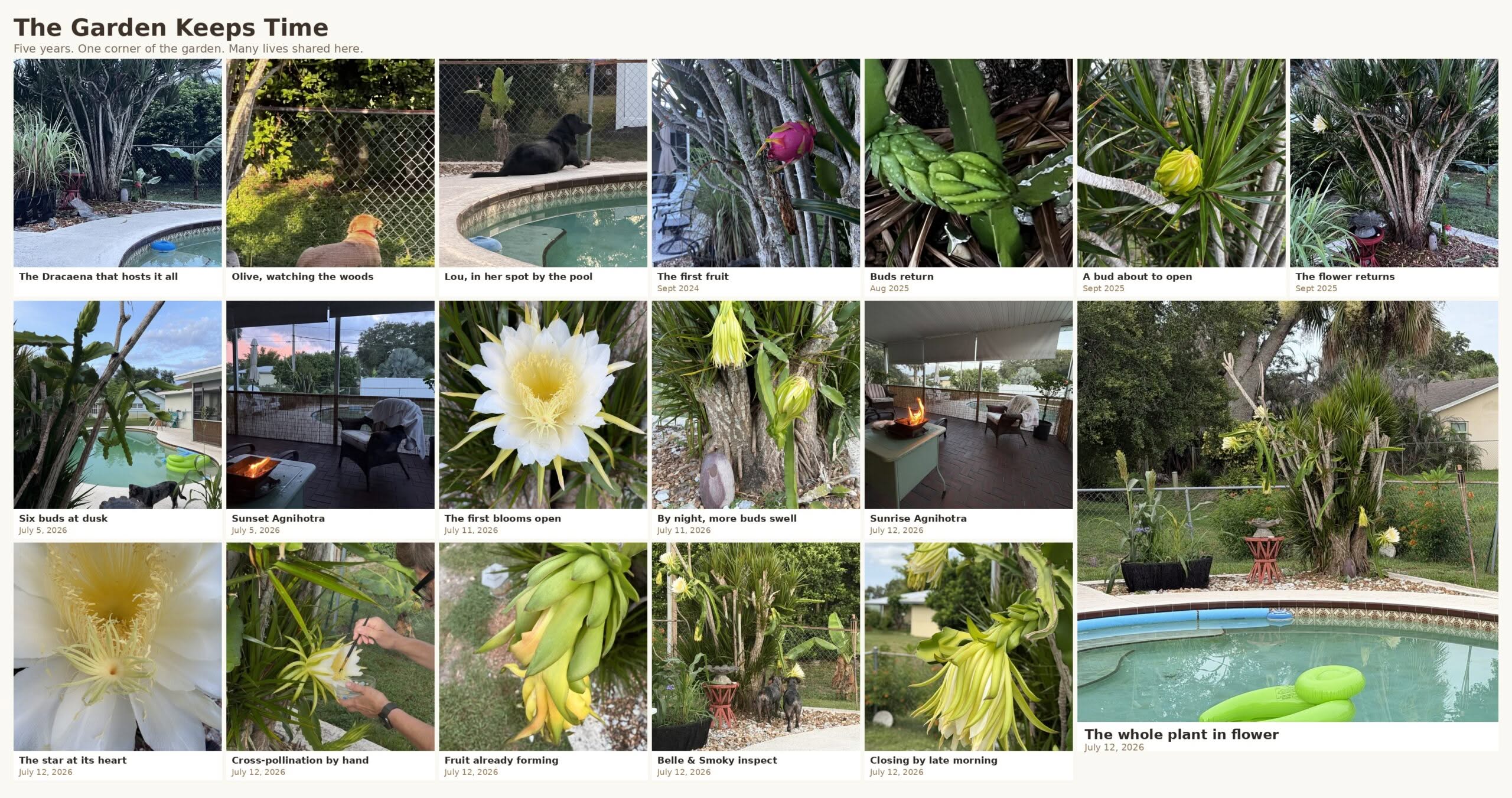
That corner has never belonged to the garden alone. Over the years, it has also belonged to our dogs. Olive and Lou kept watch there for years, lying beside the pool in the evenings, and today Belle and Smoky have inherited the same morning patrol. They are part of this story too, because they have always been part of this corner.
This summer, it bloomed with six flowers over two mornings. It would be easy to tell that as a story about six flowers. It isn’t. It is a story about the years before them.
Planting a Partnership
In 2020, I planted the dragon fruit at the base of a large, established Dracaena. Dragon fruit is a climbing cactus, and it needs something to hold onto. I could have given it a wooden post or a concrete trellis. Instead, I chose a living tree, so that the support would grow and change along with the cactus rather than simply hold it up.
I didn’t think of it as buying a plant. I thought of it as planting a partnership. One that would take years to reveal itself and become part of the garden rather than a structure standing in it.
Four Quiet Years
For the next four years, almost nothing happened that a passerby would notice. The cactus put down roots. It sent up stems. It climbed the Dracaena’s trunk and settled in. There were no flowers and no fruit, only slow, patient establishment.
I have come to believe that nature often works hardest when it appears to do the least. Under the surface, in those quiet years, the plant was building everything it would later need. I simply had to let it.
The First Flower
Then, in August 2024, after four years of waiting, a single flower appeared almost overnight. Lou, one of our dogs, noticed it before I fully understood what I was seeing and went to investigate.
A fruit developed exactly where that flower had bloomed. I still have the photograph of it, deep pink against the pale trunk, with the dried blossom still hanging beneath it like a signature marking the spot. That first fruit gave the plant its first place in memory. I began, without quite deciding to, to keep a record.
Learning to See
The second season, in 2025, was when I actually started to see the plant rather than just look at it.
The original spot flowered again and fruited again. Then something new happened. A second flowering site appeared elsewhere on the cactus, and Lou went to investigate that one too. By the end of the year, the plant had two places that knew how to bloom. It had begun to develop a history, and I was learning to read it.
This was also when I understood why the dogs loved that corner so much. In the evenings, rabbits emerged from the brush beyond the fence, and squirrels raced along the branches overhead. Olive and Lou would lie quietly in the shade beside the pool, watching the small dramas of the garden unfold. It was as much their place as it was mine.
The Freeze and What Came After
Gardens don’t move in a straight line, and this one reminded me of that over the winter. A freeze damaged the Dracaena badly enough that it had to be cut back. The obvious worry was the dragon fruit. Would it lose the support it had spent four years learning to climb? Would the flowering slow down?
The dragon fruit stayed. In the spring, the Dracaena began to recover, the cactus kept climbing, and with the tree cut back, more light and air reached parts of the plant that had been shaded before. The partnership didn’t end. It changed. I watched it change rather than assuming I knew how it would go.
The seasons turned in other ways too. Olive shared this garden through 2025, and Lou through the following spring. Belle and Smoky now keep the same corner, walking the same paths, lying in the same shade. I don’t need to say more than that. The garden carries it.
Sunrise
Most of my mornings begin outdoors. Whenever I am able, the day starts with Agnihotra, a small fire I tend at sunrise and again at sunset. It is a practice I have kept for more than twenty years, on several continents and in many different climates, and it is a discipline in its own right rather than something I do for the garden. But it means that when the garden does something worth seeing at first light, I am already there to see it. The blooms didn’t call me outside. I was outside anyway.
For me, Agnihotra is not gardening. It is a practice that has become inseparable from the way I garden. The fire and its ash have become part of how I care for the land. The ash is never discarded. It is tilled into the soil, worked in when I plant every tree, fruit, and flowering plant, and spread across the garden through the year. It is not a top dressing scattered on the surface. It becomes part of the soil itself, alongside compost, mulch, and rainwater. My confidence in doing this doesn’t come from reading about it. It comes from decades of practice and observation.
Agnihotra has been the subject of scientific investigation for decades, with published studies exploring its effects on air quality, water, agriculture, and soil. Anyone who is interested can read that body of research and weigh it for themselves. My purpose here is different. I am simply sharing what has become part of my own experience and part of how this small piece of land is cared for. I will write more about the practice itself in a later post.
Six Flowers, Two Mornings
This summer, the years came together.
At sunset one evening in early July, I noticed six buds on the cactus, swollen and ready. They were not scattered at random. The original site from 2024 carried two of them. The second site, the one that first appeared in 2025, carried four. What looked like a sudden abundance was really the two places I had been watching for years, both blooming at once, each according to its own history.
The next morning, three of the flowers had opened. Dragon fruit flowers bloom overnight, reach their full beauty at sunrise, and close again before noon, so there is only a small window to meet them. I cross-pollinated those first three by hand. The following morning, at Agnihotra time, the other three opened, and Belle and Smoky came to inspect them as though every new bloom were their responsibility to approve. I pollinated those as well, and by late morning, they were already closing.
Participation
This is the part of gardening I have grown to love most, the part where I stop being a spectator.
When a dragon fruit flower is fully open, its center holds a pale star of stigma surrounded by a crown of pollen-heavy stamens. In the wild, moths and bats do this work at night. In my garden, at sunrise, I do it by hand, using a small soft brush to lift the loose pollen and carry it from flower to flower, then photographing the star at the heart of each bloom before it folds away.
Not every flower becomes fruit. One of the blooms in my record opened beautifully and simply never set. That is part of the honest story of a garden. You participate, you tend, and then you let the plant and the season decide the rest.
The Garden Keeps Time
Over time, I realized I wasn’t simply growing plants. I was creating a habitat. Every new tree, flowering plant, and patch of healthy soil invited something else to arrive. Bees appeared with the blossoms. Birds began visiting more frequently. Butterflies found nectar. Dragon fruit flowers opened for the night pollinators. Even Belle and Smoky made the garden part of their daily patrol, stopping to investigate each new bloom as though it were their responsibility to inspect every change. Our animals are not separate from the garden. They are our companions within it.
Looking back through five years of photographs, I realized I hadn’t documented a dragon fruit cactus. I had documented the memory of a garden. Not memory in the human sense, but the way a living landscape returns to familiar places, season after season. The first fruit appeared here. The next year, another flower opened there. This summer, those same places bloomed again with even greater abundance. The garden remembers, not because it thinks, but because living systems build on what came before. Every season leaves its mark, and the next season grows from it.
That is why this corner has stayed with me. Whether I am designing software or tending a garden, I have learned that healthy systems are built on relationships, not isolated parts. The dragon fruit and the Dracaena. The ash and the soil. The bees and the flowers. The rabbits and the grass, the dogs who watched the rabbits, and the gardener who watched them all. Nothing in that corner works alone, and neither does anything worth building.
Over time, I realized I wasn’t simply cultivating a garden. I was caring for a place that many lives had come to share. The dragon fruit climbed the Dracaena. Rabbits visited in the evening. Squirrels raced through the branches while Lou watched them from her favorite spot beside the pool. Birds nested overhead. Bees and moths visited the flowers. Belle and Smoky now pause each morning to inspect the newest blooms, just as Lou once did. Stewardship, I have learned, isn’t measured only by what we harvest. It is measured by the life that chooses to make a home there.
As for the six flowers, within a week I will know which have set into fruit and which will quietly fall away. The ones that hold will take about a month to ripen. I have done my part. The rest, as always, belongs to the garden. It keeps its own time, and it has taught me to keep mine.