
This is the first post in When to Slow Down, a nine-part summer series exploring gardening, stewardship, observation, and the lessons that quietly shape how we build our lives, our businesses, and our technology.
It’s midsummer in Florida. While many assume the gardening season has come to a standstill under the summer heat, I’ve been outside with my hands in the soil: planning raised beds, mulching the fruit trees, improving the soil, and preparing for the season ahead.
Looking around, I realize this garden didn’t begin this summer. It has been quietly taking shape for years. In many ways, I feel as though I’ve found my way back to where I began.
To some, it may seem like an unusual contrast. By day, I design software, build AI systems, and solve complex technology challenges. Yet when I step outside, I’m reminded that many of the principles guiding my work today existed long before computers ever did.
Roots
I was born into a farming family. My roots run through both the American South and Belize’s South, where farming was a way of life and knowledge was quietly passed from one generation to the next.
Like many people, however, my own path took me elsewhere. I built businesses, embraced technology, traveled extensively, and immersed myself in an entirely different world.
Then, at twenty-eight, I found myself in Pucallpa, Peru, for what became a three-month immersion unlike anything I had experienced before. I helped plant 10,000 bolaina blanca trees that would later be transplanted into the Amazon. I learned to cultivate Biosol, a natural fertilizer made from earthworm castings, cow dung, and Agnihotra ash. There, I first experienced Homa farming and Vedic agricultural principles rooted in the Atharva Veda, as well as biodynamic agriculture. I did not know it then, but that season would quietly reshape how I understood almost everything that came after.
It was more than a different way of farming. It was a different way of seeing the world.
I gradually realized that farming wasn’t only about producing food. It was about stewardship: leaving the land healthier than you found it and understanding that every season is an investment in the next.
The Same Principles, Everywhere
Over the years, that journey carried me across continents. I’ve spent time among remarkable farming communities in Belize, South America, and India, and among the peasant farmers of Eastern Europe, who grow through the summer and preserve their harvest for the long winter. I’ve also had the privilege of learning within some of the world’s great agricultural landscapes, including the tea estates of Darjeeling and Assam and the coffee plantations of Karnataka and Tamil Nadu.
The languages were different. The climates were different. The crops were different. Yet everywhere I went, I found the same principles quietly at work. The best farmers prepared well. They wasted little. They observed carefully. They respected the seasons. Above all, they understood that tomorrow’s harvest is determined long before it is ever seen.
It took me years to realize those weren’t only principles of agriculture. They were principles for building almost anything that lasts. Whether I was starting a business or designing software, I kept returning to the same truth I had first learned in the fields: tomorrow’s harvest is determined long before it is ever seen.
Knowledge That Is Lived
Those principles didn’t stay behind on the farms I visited. They followed me home. My Uncle Greg grew up farming alongside my grandfather in Belize, and today he lives with me. He never learned from textbooks; he learned from the land itself. Watching him work the soil with quiet confidence reminds me that some knowledge survives not because it was written down, but because it was lived.
Where Technology Meets the Soil
Technology has given us extraordinary tools. We can analyze soil, forecast the weather, automate irrigation, and use artificial intelligence to optimize almost every aspect of agriculture.
I embrace those tools.
But I also believe there are things no instrument can fully replace: the feel of healthy soil in your hands, the smell of rain before it arrives, the movement of air through a field, the subtle change in a plant that tells you something is different, and the quiet awareness that develops only by spending time with the land.
My own approach is to use technology where it serves us well while honoring practices that have shaped my understanding of stewardship. I grow as organically as I reasonably can. I can build healthy soil, choose what I place into it, and care for the life within my own garden.
What I cannot control is every drop of rain, every shift in the wind, or everything that may drift in from beyond my property.
What I can do is choose how I care for the land entrusted to me. Over the years, I’ve adopted practices that reflect that philosophy. I compost, I mulch, and I plant trees that will take years to mature. And I continue the daily practice of Agnihotra that I first experienced in Peru more than 23 years ago. As my garden takes shape, it naturally becomes part of how I tend it. I don’t see these as competing with modern agriculture. They are simply part of how I’ve learned to cultivate the land with intention. I’ll share more about Agnihotra and why it has remained part of my life in a later post.
That realization also made me appreciate something else. Gardens rarely begin where we think they do.
A Florida Vegetable Garden, Years in the Making
This garden has been years in the making, not because it was difficult, but because life has seasons of its own. For many years, my priorities were elsewhere: building companies, developing software, creating intelligent systems, teaching, traveling, serving clients, and caring for family. The vision never disappeared, though, and looking back, I realize I wasn’t postponing the garden. I was preparing for it.
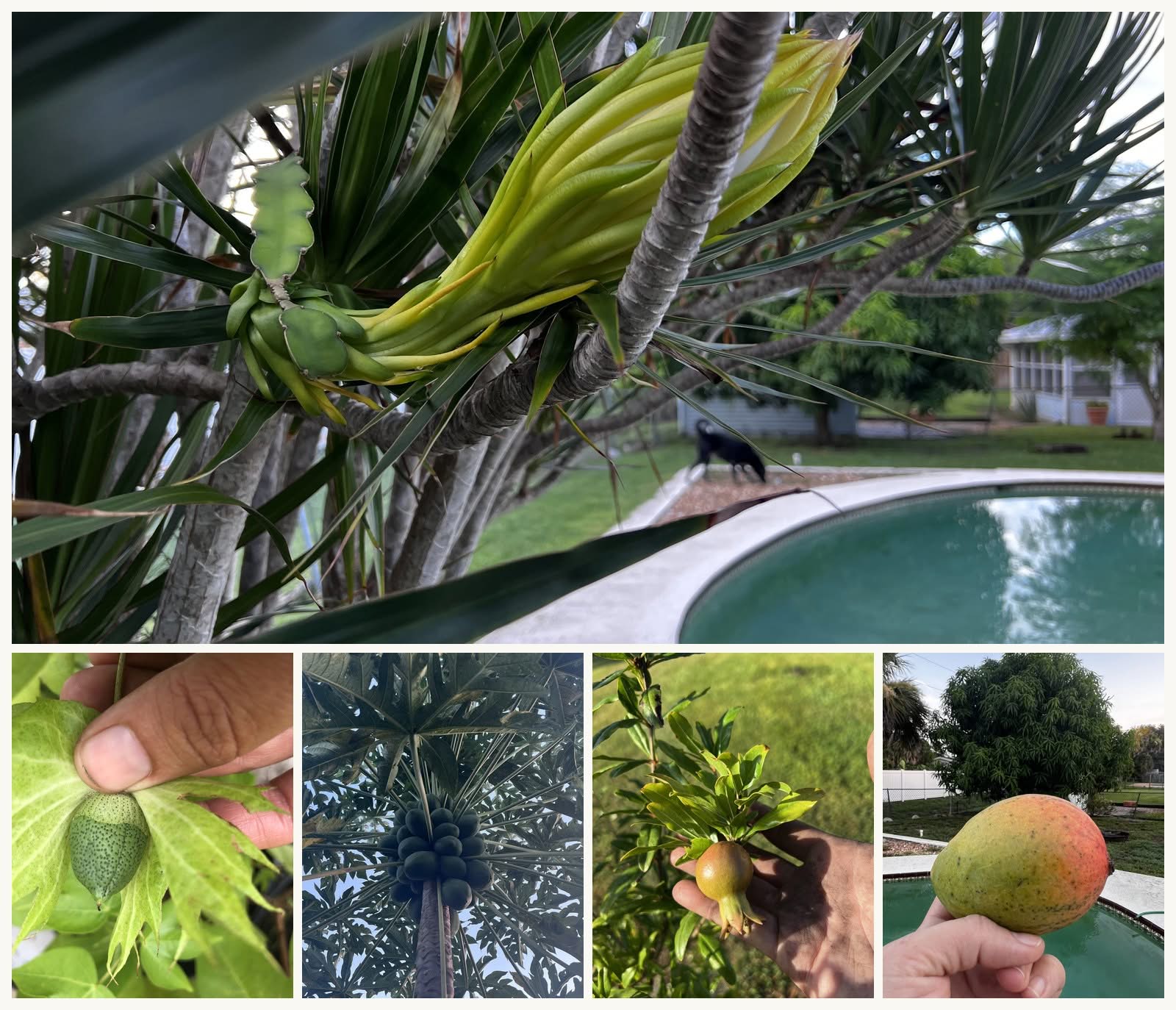
I’ve built it slowly and intentionally, one season at a time. It began with trees: mango, coconut, moringa, cotton, and papaya. Later came dragon fruit, pomegranate, and custard apple, the small cousin of the soursop. Then the ornamentals, planted not only for beauty but for the birds, the bees, and the small creatures that share this land, a Florida wild coffee hedge among them.
Seasons of Change
But gardens have a way of reminding us that we don’t control every season. Hurricane Milton took the papayas. The freeze this past winter claimed the coconuts, and the custard apples are still trying to find their way back. Many of the ornamentals struggled as well.
Yet the rains returned, and new growth followed. This season I’ve planted two more mango trees, an avocado, and two papayas. The dragon fruit is setting beautifully. The pomegranates are thriving. The moringa and mango continue to grow.
That is how gardens teach resilience. You don’t simply plant once. You observe, adapt, replant, and keep cultivating.
This summer, almost by accident, bamboo fencing and ornamentals transformed the patio into a natural extension of our indoor and outdoor living space. And now come the raised beds, built by hand.
The garden is finally ready for its next chapter: a Florida vegetable garden, a kitchen garden meant not only to grow food, but to become another expression of the life I want to live.
There will be Florida winter vegetables chosen with intention. Fruit trees cared for through another Florida summer. Perhaps, in time, even hydroponic greens on the patio. There will be experiments. There will be successes. There will be failures. And there will be lessons.
In truth, I might never have felt the push this summer if I hadn’t found corn growing where my lemongrass used to be. But that is a story for the next post.
The Season Ahead
Over the coming months, I’ll simply share what happens. Some of it will be informed by generations of agricultural wisdom, some by modern science, some by technology, and some by the quiet observations that only come from spending time with the land.
This will come as it comes, organic and slow, the way summer does. I’ll share it not as a gardening expert, but as a lifelong student, fortunate enough to have learned from remarkable people, places, and traditions.
Perhaps, in the process, we’ll discover that the principles behind healthy soil, resilient communities, and thoughtful technology have more in common than we often imagine.
After all, the best systems, whether gardens, businesses, or technology, are rarely built quickly.
They are cultivated.
One careful season at a time.