
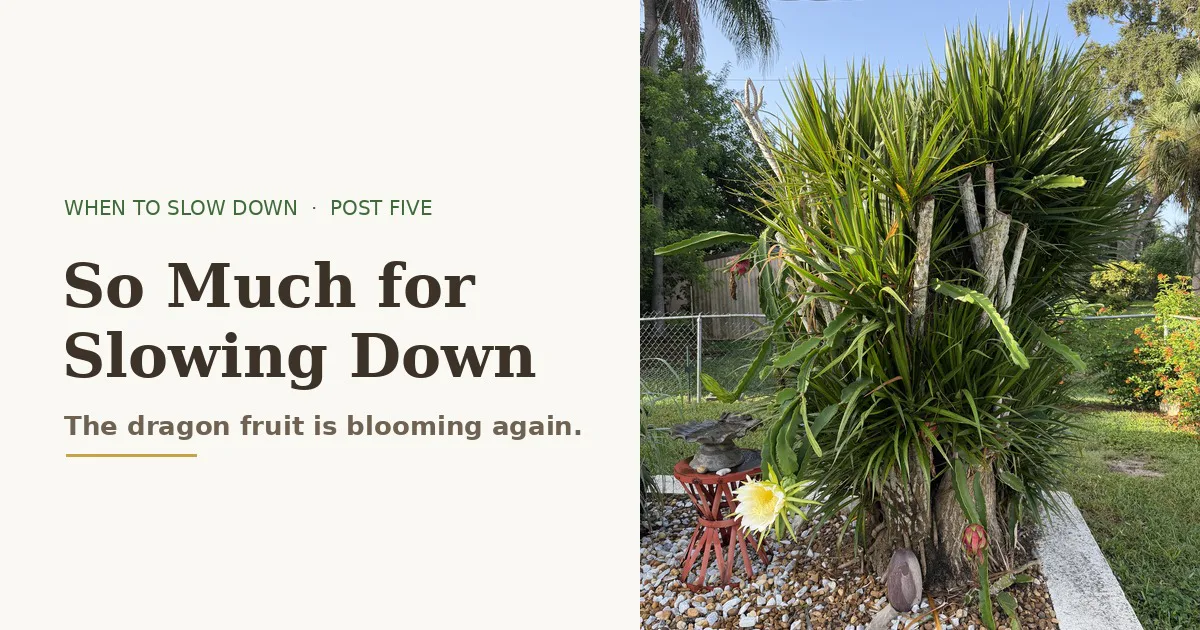
So Much for Slowing Down
This is the fifth post in When to Slow Down, a nine-part summer series exploring gardening, stewardship, observation, and the lessons that quietly shape how we build our lives, our businesses, and our technology.
We just harvested seven dragon fruits.
Seven.
They were beautiful. They were delicious. And I thought the dragon fruit and I had reached a perfectly reasonable understanding about what constituted a successful season.
Apparently, I was the only one in that conversation.
It is blooming again.
And this time, I can see the buds.
They are everywhere.
Wait. Those Are Buds?
The first time this cactus bloomed, I had no idea what I was looking at.
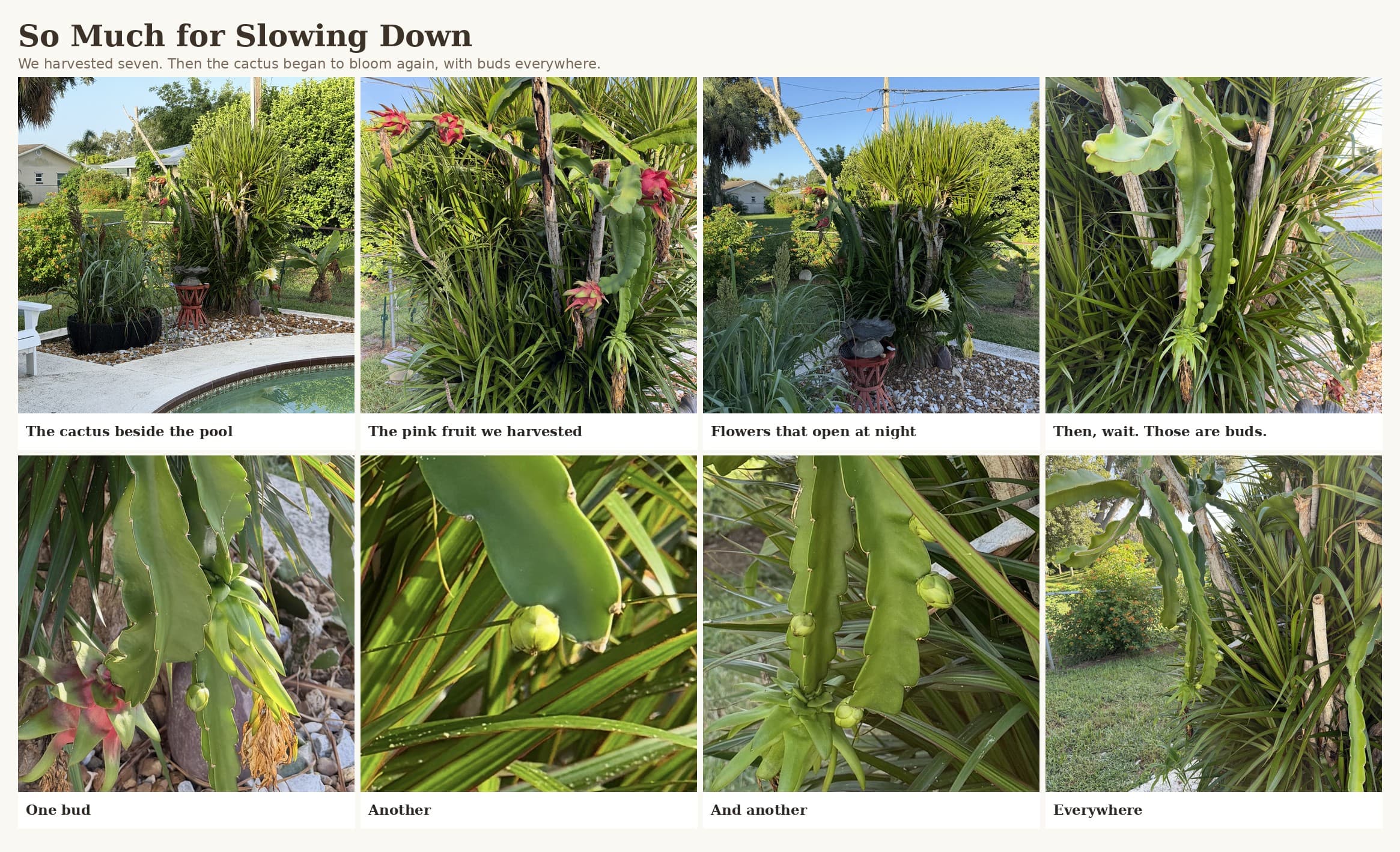
I knew we had a dragon fruit cactus growing beside the pool, but I didn’t understand its cycle. Then these enormous white flowers appeared, opening at night in a display that was almost impossible to believe.
After the flowers came the fruit.
I watched them grow, turn that extraordinary shade of pink, and finally ripen.
We harvested seven.
I was thrilled.
I also thought we were done.
Then, a few days ago, I started noticing little green growths along the cactus.
I looked at one.
Then another.
Wait.
I know what those are.
Those are buds.
Once I recognized the first one, suddenly I could see them everywhere.
Tiny ones just beginning to emerge. Larger ones stretching outward. Buds tucked into places I would have walked right past a few months ago without giving them a second thought.
I started moving around the cactus looking for them.
There was another.
And another.
And another.
Good grief.
So much for slowing down.
The Cactus Didn’t Change. I Did.
That may be the most interesting part of this entire experience.
I am looking at the same plant.
The buds haven’t changed their appearance to accommodate my education.
What changed was my ability to recognize them.
The first time through the cycle, I noticed the spectacular things.
The enormous flower.
The bright pink fruit.
The harvest.
Of course I did. Those things announce themselves.
But now I have seen what happens before the spectacle.
I have watched a bud become a flower, a flower become a fruit, and a fruit become something I could pick and eat.
Experience gave meaning to something that previously would have looked insignificant.
A tiny green bud is no longer just a tiny green bud.
It is information.
We Love the Fruit
We do this in business too.
We pay attention to outcomes because outcomes are easy to recognize.
Revenue.
A new customer.
A successful launch.
A completed project.
Growth.
Those are our bright pink dragon fruits.
We measure them, report them, celebrate them, and build dashboards around them.
But an outcome is the end of a much longer story.
Before the sale, someone asked a question.
Before the customer left, something changed.
Before the process failed, someone probably noticed that it was becoming harder to do.
Before one employee became indispensable, knowledge had quietly accumulated in that person’s head.
Before an opportunity became obvious, there were usually small signals pointing toward it.
The buds were there.
The question is whether anyone knew what they were looking at.
Experience Changes What We Can See
There is an important difference between having information and understanding what that information means.
Organizations collect enormous amounts of information.
We have databases, reports, analytics, dashboards, emails, documents, meeting notes, customer histories, and now AI systems capable of processing more information than any one person ever could.
But collecting information is not the same thing as organizational intelligence.
Intelligence develops when experience gives information context.
Someone has seen this before.
Someone remembers what happened next.
Someone recognizes that the small thing everyone else is walking past may actually matter.
And then the organization does something particularly important: it preserves that knowledge so the next person doesn’t have to begin again from zero.
That is how experience becomes institutional knowledge.
And it is how an organization becomes better at recognizing its own buds.
The Messy System Beside the Pool
There is another thing I love about this dragon fruit.
It is not neat.
It has grown up and through an old Dracaena beside the pool. Over the years the two have become one, and the Dracaena is thriving right alongside it. The cactus wraps around whatever it can reach. Some branches hang down. Others disappear into the vegetation. Old flowers remain while new buds emerge nearby. Fruit can be developing in one place while another part of the cactus is preparing to flower.
If I judged the system only by how orderly it looked, I might completely misunderstand it.
Because it is extraordinarily productive.
Organizations can look like that too.
Knowledge doesn’t always live where the organizational chart says it should.
Sometimes the person who understands a critical process has no impressive title.
Sometimes the workaround everyone dismisses contains important information about a flaw in the system.
Sometimes something that looks messy has adapted for a reason.
Before we clean it up, automate it, reorganize it, or replace it, we should probably understand what it is doing.
There may be dragon fruit in there.
And Apparently, We’re Not Done
I have no idea how many of these buds will become flowers.
I don’t know how many flowers will successfully become fruit.
And after seven dragon fruits, I have learned better than to announce that I know what this cactus is going to do next.
Nature has already corrected me once.
But I do know something I didn’t know before.
I can recognize the beginning of the cycle.
That changes the way I look at the entire plant.
And perhaps that is one of the most valuable things experience gives us.
Not certainty.
Recognition.
The ability to look at something small and seemingly insignificant and say:
Wait. I know what that is.
So yes, I am slowing down.
I am observing.
I am learning.
The dragon fruit, on the other hand, appears to have its own strategic plan.
And apparently, it is not taking the summer off.