
The Empty Seat
This is the fourth post in When to Slow Down, a nine-part summer series exploring gardening, stewardship, observation, and the lessons that quietly shape how we build our lives, our businesses, and our technology.
The flight home wasn’t full.
I had a window seat. A gentleman was sitting beside me in the middle seat, but the aisle seat was empty. In fact, the row in front of us was empty, and so was the row directly across.
I had my AirPods in, listening to an audiobook and playing a game, while he kept looking around at all those empty seats.
Finally, he asked the flight attendant if he could move after takeoff.
She said yes.
He never moved.
The Conversation
Somehow, we started talking.
I don’t remember exactly how the conversation began, but before long we were talking about gardening. I mentioned what I was doing at home, and the conversation turned to growing vegetables in Florida and then to hydroponics.
Little did I know who was sitting beside me.
This gentleman could grow just about anything.
For most of that short flight, perhaps an hour and a half or two hours, he taught me.
He talked about hydroponics, tower gardening, nutrients, irrigation, growing media, and drainage. He explained what worked in our Florida climate and, just as importantly, when to do it.
Several of the vegetables I had already assumed would be difficult, perhaps even impossible, to grow successfully here were things he grew.
He told me I could grow them too.
Then he told me when to start, how to manage them, what to watch for, and what not to do. His instructions were surprisingly simple. If I paid attention to the timing and did a few things consistently, he told me, the garden would thrive.
At some point, the game disappeared.
I started taking notes.
Passed From One to Another
Then he told me something else.
Much of what he knew had been taught to him by an old-timer.
That stayed with me.
These weren’t simply instructions someone had looked up. Someone had spent years learning how to grow successfully, then passed that knowledge to him. He had taken it, applied it, learned from it, and made it part of his own experience.
And now, for reasons neither of us could have planned, he was sitting in the middle seat of an airplane passing some of it to me.
I didn’t tell him everything I was already doing in my garden. I didn’t explain Agnihotra, the ash I use, or Biosol. I wasn’t interested in comparing methods or demonstrating what I knew.
I listened.
For that hour or two, I had the good sense to recognize that someone knew something I didn’t.
And I soaked it in.
When You’re Ready
Something is interesting about when this conversation happened.
A few months earlier, much of what he told me might have been interesting, but it would not have meant the same thing.
By the time I boarded that plane, I had been working in the garden. I had been watching what survived and what didn’t. I had been learning the Florida seasons instead of assuming I understood them. I had been improving the soil, thinking about irrigation, planning raised beds, and paying much closer attention to how things grow.
I was ready to hear him.
Since coming home, I’ve ordered the raised beds. The trellises are coming. So are the coconut coir and drip irrigation supplies. My next purchases will likely include two 55-gallon drums: one for the growing system he described and another to collect rainwater.
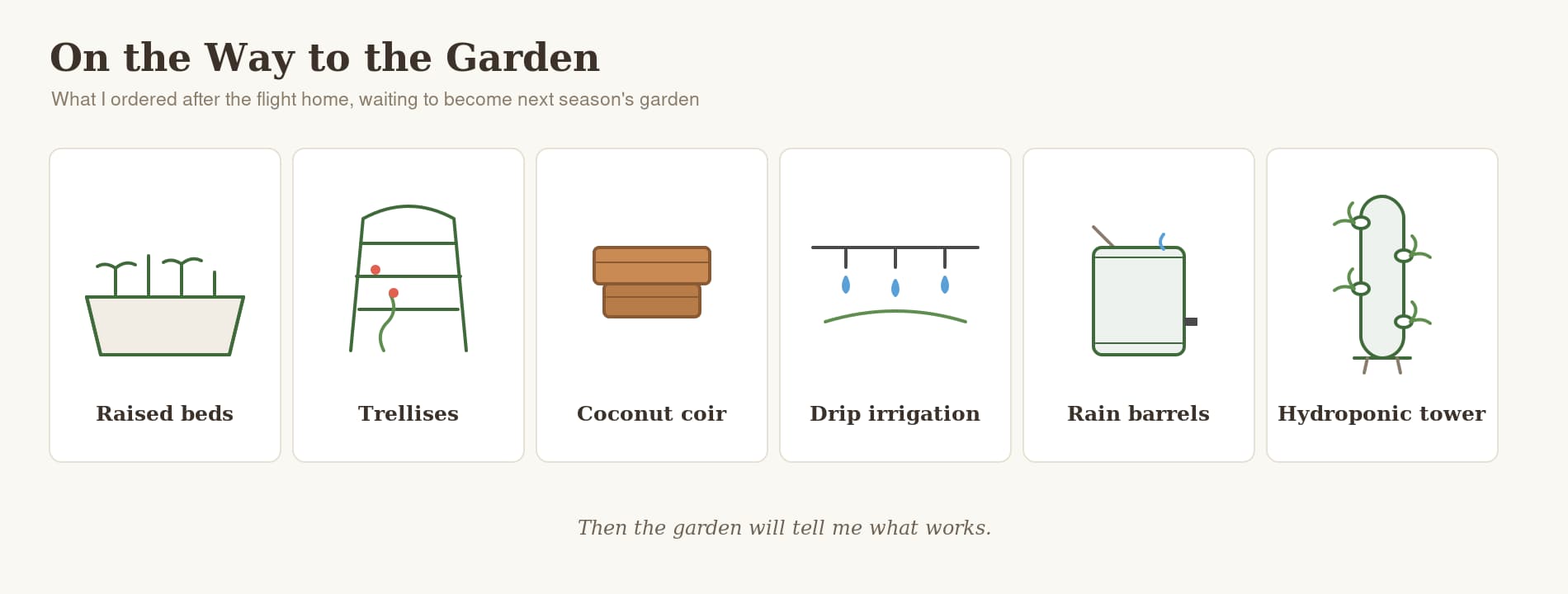
Then I will take what he taught me and bring it into the garden I am already building, alongside the practices I already use.
His knowledge doesn’t replace mine.
It adds to it.
And then the garden will tell me what works.
How Knowledge Travels
I kept thinking about the old-timer who had taught him.
I don’t know his name, but some of what he learned is still moving through the world. He taught someone. That person applied what he learned, added years of his own experience, and then passed some of it to me.
This is how knowledge has traveled for generations.
And in many ways, it is the same challenge we are trying to solve today, both within our organizations and through technology. How do we preserve what people learn through experience? How do we make sure that what one person discovers doesn’t disappear but becomes available to the next person who needs it?
Organizational intelligence begins there. Not with the technology, but with recognizing that experience itself is valuable knowledge.
Technology can help us preserve it. AI can help us connect it, retrieve it, and learn from it. But first, someone has to listen.
The Middle Seat
There was another part of our conversation that I haven’t mentioned.
He was traveling home after visiting his brother, who was gravely ill.
Against that backdrop, our long conversation about vegetables, hydroponics, and growing things took on a different meaning.
Near the end of the flight, he thanked me.
“Thank you for taking my mind off of my brother,” he said.
Then he told me he would be gardening again.
For most of the flight, I had thought I was the one receiving the gift. I was leaving with pages of notes, new ideas, and the confidence that I could grow things I had thought our Florida climate had put beyond my reach.
But the exchange had gone both ways. He had given me knowledge that had once been given to him. And somehow, in asking him about it, listening, and letting him teach me, I had helped reconnect him with something of his own.
We wished each other well before we parted. I told him I would pray for him and his family.
I keep coming back to the beginning of that flight.
There were empty seats everywhere. He noticed them. He even asked if he could move. He had permission.
Yet he stayed in that middle seat.
Had he moved, I probably would have continued listening to my audiobook and playing my game. He would have gone wherever he was going. I would have gone home with exactly the gardening knowledge I had when I boarded.
Instead, two strangers spent a short flight talking about growing things.
Sometimes the door opens because we have been pushing on it for months.
And sometimes it looks remarkably like a man who could have sat anywhere on the plane but, for whatever reason, stayed in the middle seat.