
I’ve Been Growing Money for Twelve Years
When to Slow Down, Part 6. A series about gardening, stewardship, observation, operational intelligence, and the lessons that quietly shape how we build our lives, our businesses, and our technology.
Twelve years ago, I bought a Money Tree at a farmers’ market.
I wasn’t making an investment. I bought a plant.
The name, by the way, is folklore rather than botany. Pachira aquatica picked up its name through Feng Shui and a good story, and growers have been braiding the stems and selling it as good fortune ever since.
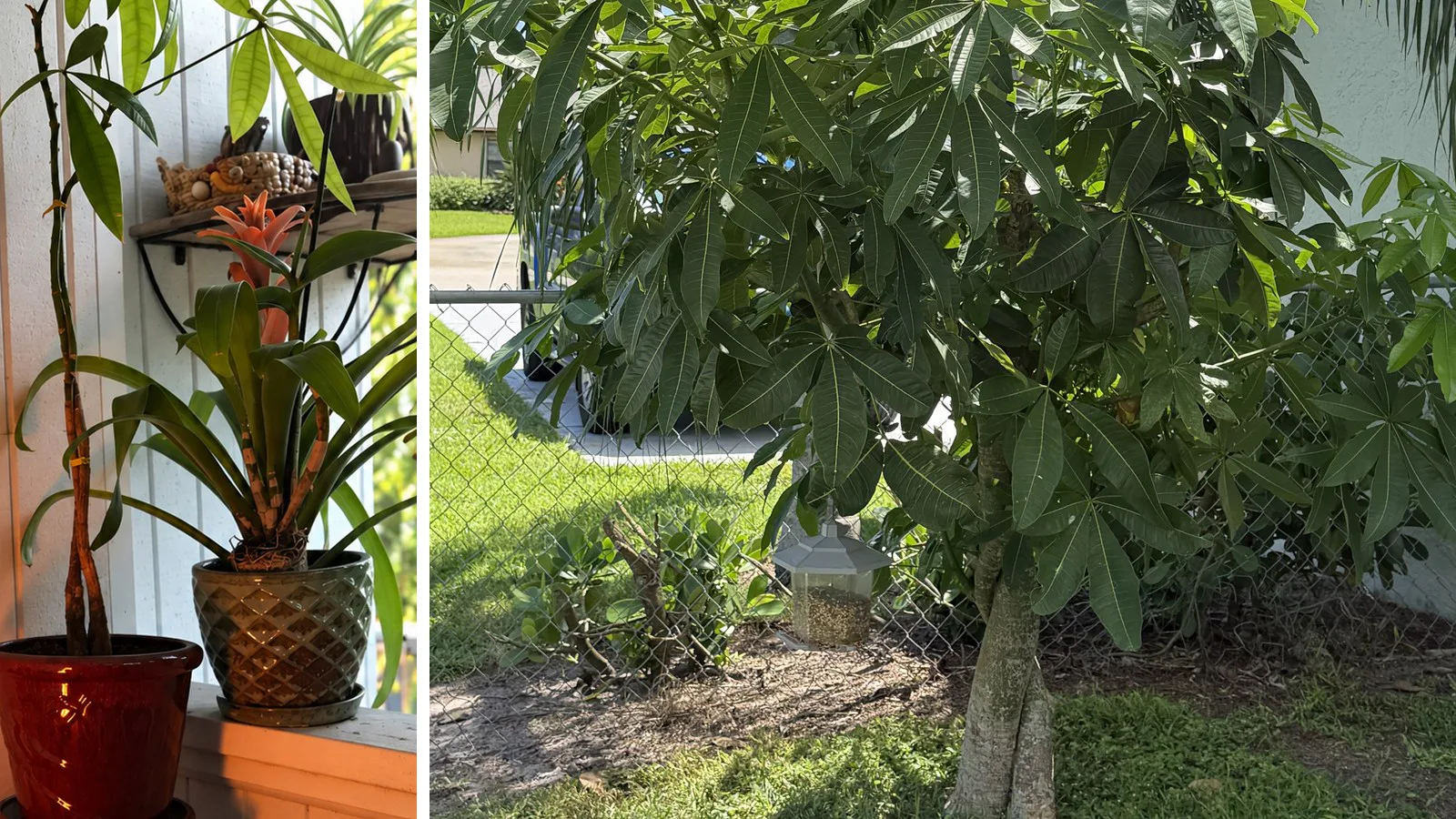
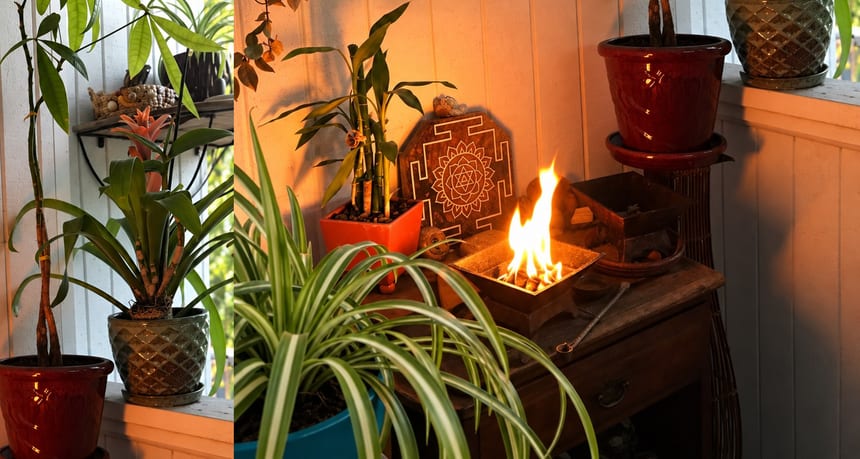
Mine was two thin stems in a red pot, living on my apartment balcony. Agnihotra is burning on the table beside it. It shared that balcony with lucky bamboo, a spider plant, and a bromeliad, and it was the tallest thing out there by a good margin.
It moved house with me more than once. Then someone gave it something a Money Tree rarely gets.
The ground.
And apparently, it had plans.
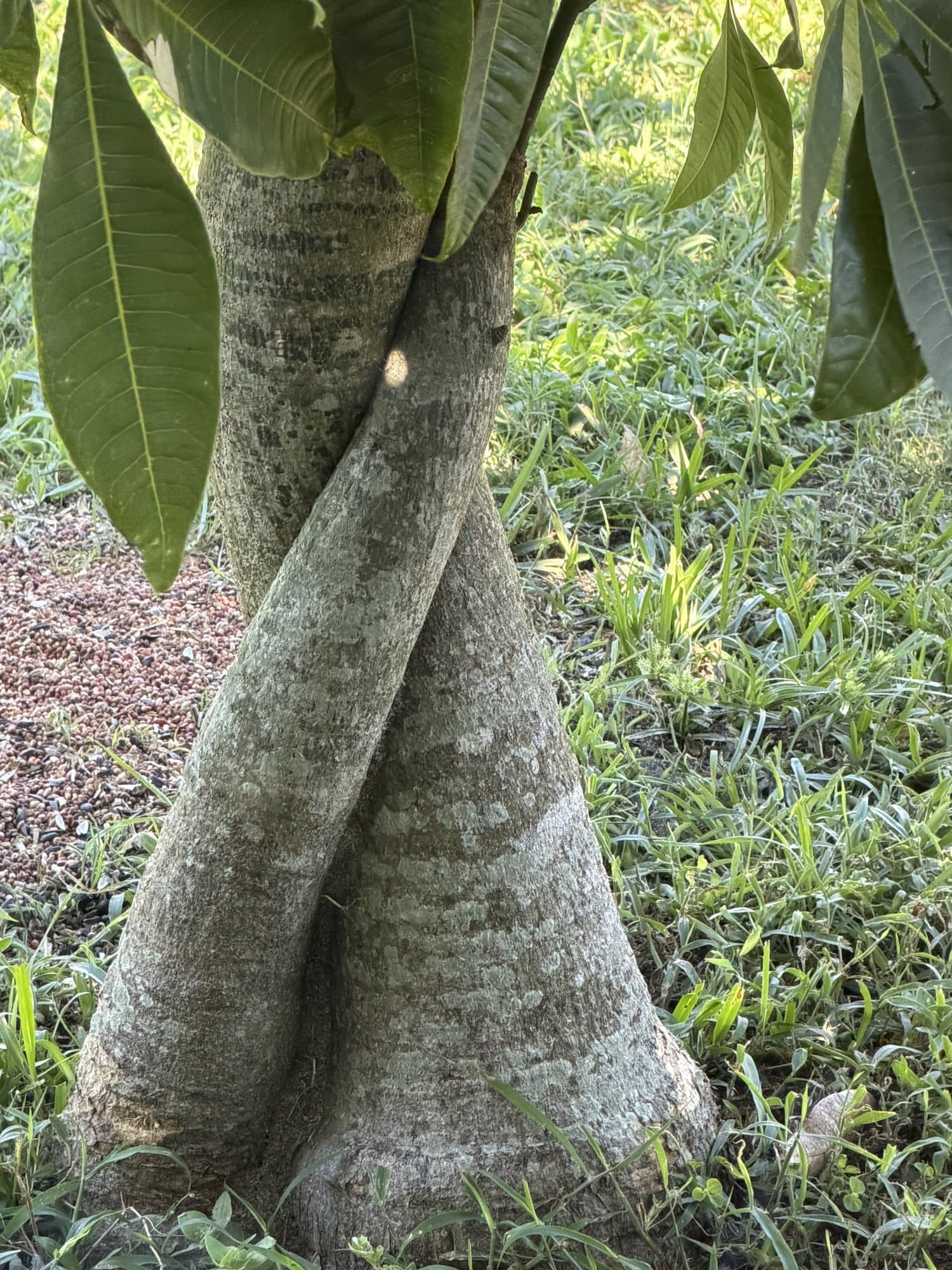
That braid is still there. It has become structural. Two trunks wound around each other, fused where they cross, each one about the thickness of my leg, flaring out at the ground into buttresses.
I cannot fit both hands around it.
The braid was cosmetic when I bought it. Now it is the trunk.
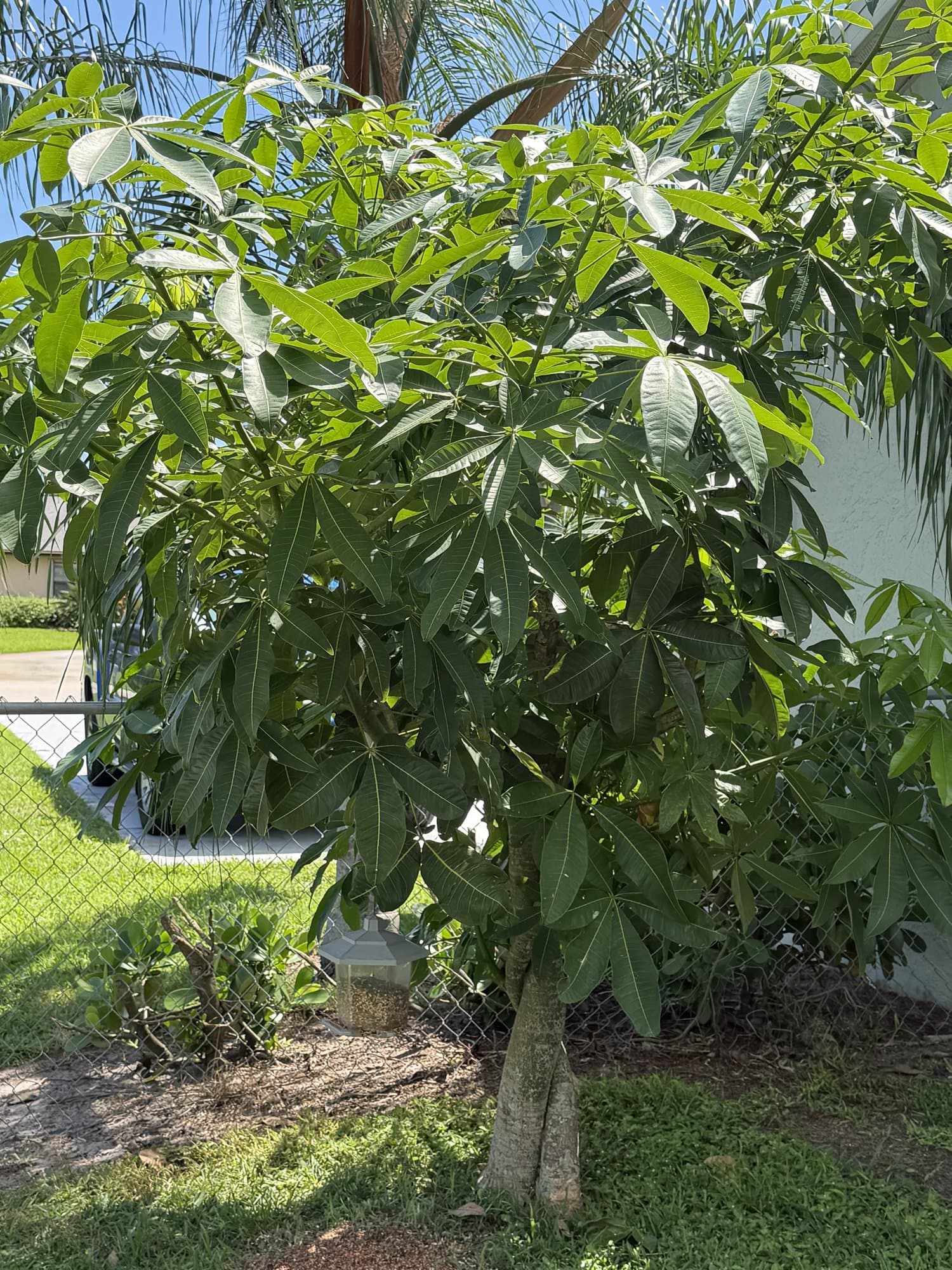
The leaves are the size of my hand. It shades that side of the house. A bird feeder hangs from one of its branches, and the birds treat it as theirs. It holds its corner of the yard as though that is where it always intended to be.
The name promises abundance. Abundance, it turns out, comes in more forms than one.
Which is appropriate, because When to Slow Down has apparently decided it will finish when it is good and ready.
It is officially fall, and my slow summer series is still going. Summer ended before I finished writing about it, but perhaps that is fitting. These stories were never meant to follow a publishing calendar. They came when the garden gave me something worth noticing.
And while I have been writing, the garden has kept moving.
The raised beds are installed. Thanks to all the rain, the water tank is full. Nature completed her portion of the project well ahead of schedule. I cannot say the same.
Meanwhile, the lemongrass I thought I had lost to the winter freeze has returned, and apparently reached a settlement with the millet the birds planted in its place.
I have not been informed of the terms.
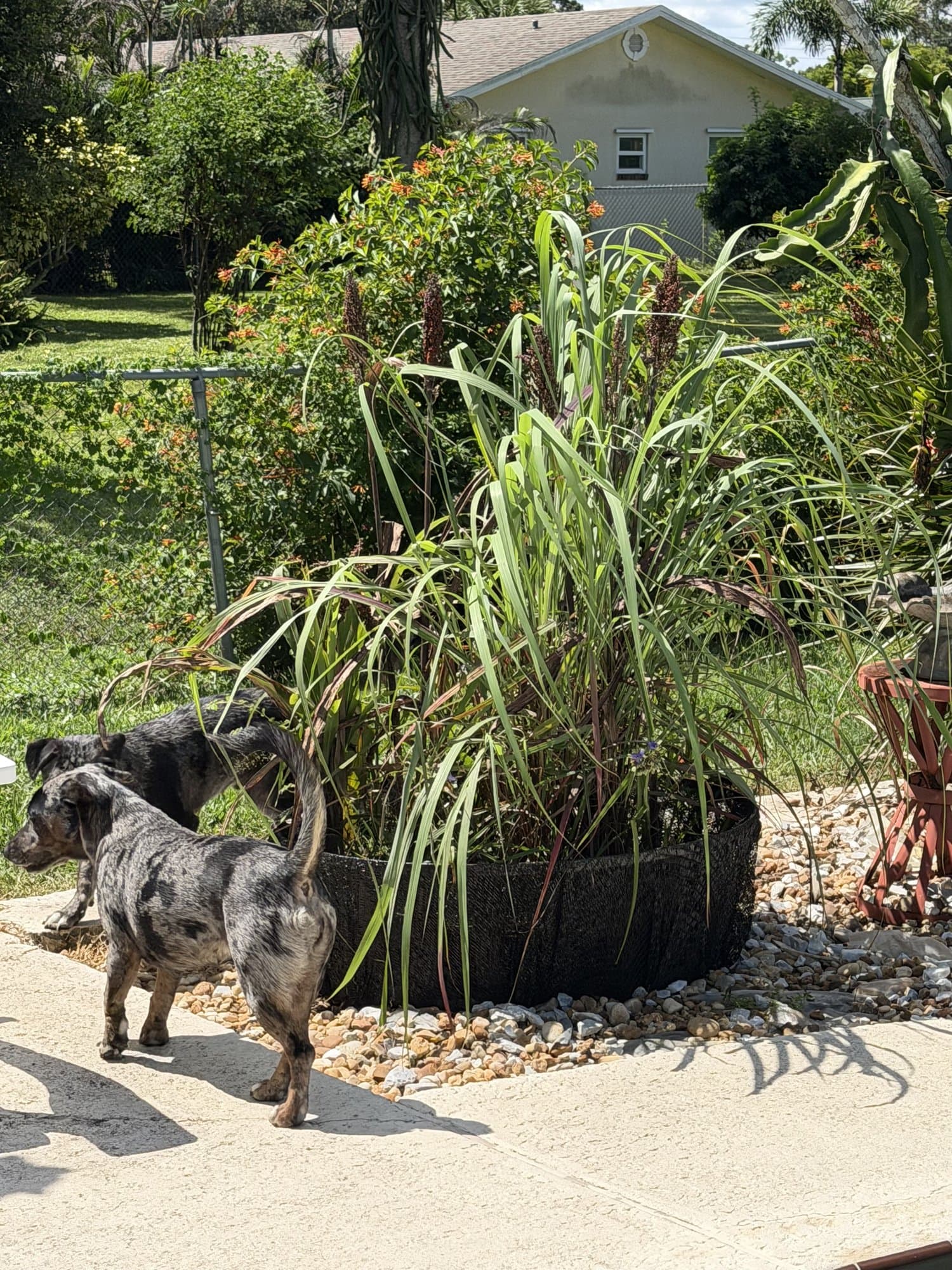
Readers of I Thought It Was Corn will appreciate how unexpected that arrangement is. The lemongrass is filling that planter and pouring over the rim, with the millet still standing right there in the middle of it.
The garden, it seems, wasn’t finished with that story either.
The Knowledge That Came Home
The beds still need filling. But before I plant them, I need to make something else.
This part isn’t new to me. I first learned to make Biosol in the jungles of Peru. That sentence sounds considerably more exotic now than it did when I was there.
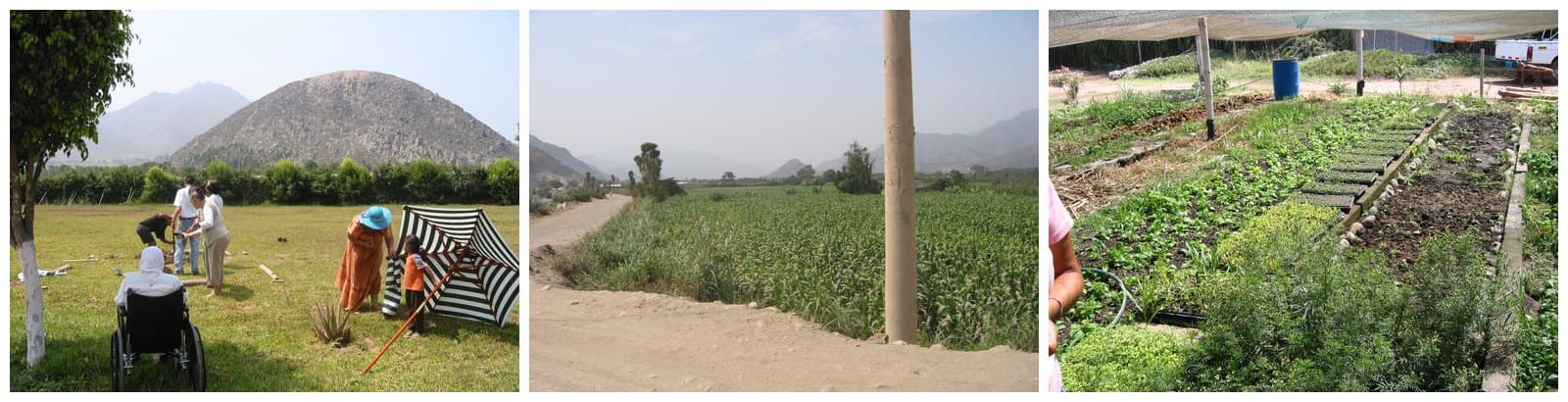
Along with other Homa Therapy teachers, I traveled teaching Homa Organic Farming. The goal was self-sufficiency. We were there to teach farmers how to apply it in their own operations, so the knowledge would remain after we left.
At its foundation are the Vedic fires: Agnihotra at sunrise and sunset, along with other fires. Biosol is one of the agricultural preparations, surrounded by broader Vedic farming principles that in some respects are akin to Biodynamic farming. Agriculture is understood as a living system in which soil, atmosphere, water, plants, animals, people and natural cycles are interconnected.
The work ran from small peasant farms in the United Kingdom and Europe to large-scale agriculture in Central America, South America and India. In India alone, thirteen tea estates across Darjeeling and Assam, hundreds to thousands of hectares, some with entire communities living and working inside them.
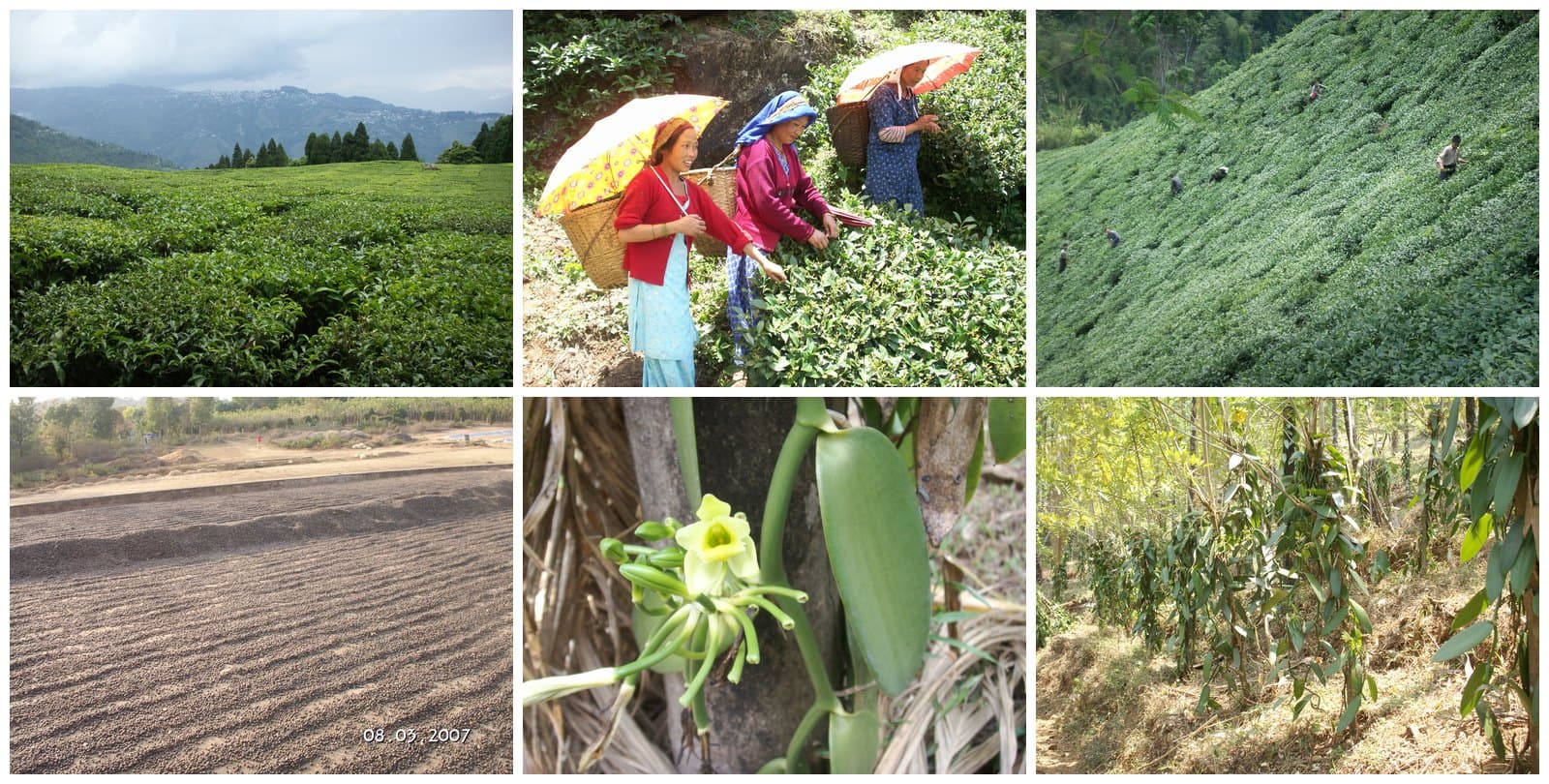
While we were teaching, I was learning from generations of farmers around the world.
We taught principles. Farmers taught us place.
In most of the photographs, I am the one with my arms in the barrel. Sometimes another Homa Therapy teacher is beside me, Karin or Juan or someone else, and we are showing a crew how to assemble large tanks of Biosol.
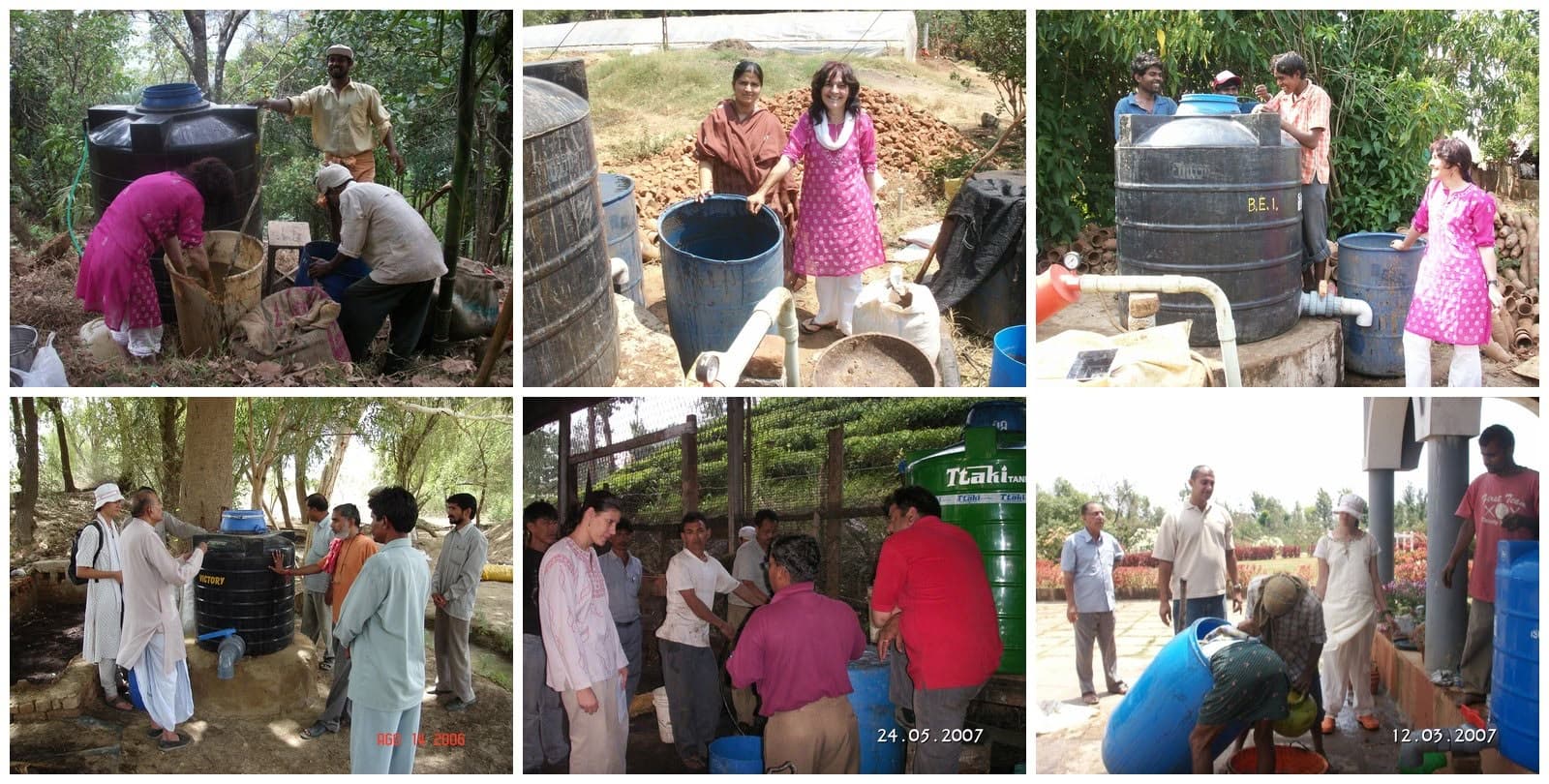
The components barely change from one photograph to the next. A poly tank. Blue and green drums. A tap, a length of pipe, a hose. Jute sacks that came in holding the organic matter. Something to stir with. And going into the barrel, always the same: organic matter, mostly fresh cow dung, and Agnihotra ash.
What changes is the arrangement. Where the tank goes, how the water gets to it, what the drums stand on, who mixes and when, and how the batches are tracked.
The principles traveled. The implementation didn’t.
The Biosol tanks were one part of the work. The rest of the invention on those farms had nothing to do with us. Contraptions of every description, rigged up by people solving a problem with what they had in front of them. I had forgotten how many I saw.
None of it was makeshift. It was intelligence made physical. Between what we brought and what the farmers already knew about their own ground, somebody worked out a version that would keep running after we left.
That was the test. The tank was only the visible infrastructure. The real infrastructure was the knowledge moving between the people standing around it.
These old photographs have handed some of it back. An old photograph brings back a place. The place brings back a system. The system brings back something ingenious that someone had worked out for that particular problem.
And I find myself thinking, I remember this.
The knowledge wasn’t gone. It had not been called upon in years.
Organizations spend enormous effort collecting information, but collection is only part of the problem. Knowledge also has to remain retrievable. Someone, or increasingly some system, has to recognize that something learned years ago is relevant to the problem on the table today.
Sometimes the problem isn’t that knowledge was lost.
It’s that no one remembered to ask for it.
Let’s Maintain Perspective 😂
More than twenty years after Peru, I am preparing to make Biosol again.
Not for an operation covering thousands of hectares. Not a tea estate. Not a coffee plantation.
A few raised beds in my backyard.
I know how to make the Biosol. The contraption I intend to build around it is another matter.
In my defense, I design systems for a living. The garden never stood a chance.
Which brings me to the two tanks standing outside my house. A 66-gallon tank at one end, full of rainwater, and a 13-gallon drum at the other, holding the Biosol. The big tank waters. The small drum feeds, pumping Biosol into the same lines at intervals, so the beds are fed on a schedule instead of me carrying it out there by hand.
The drip lines are bought, and they came with fittings. What I do not have is a pump.
Or, if we are being completely truthful, any certainty that what I have designed in my head is going to work.
How often, and how much, is still in my head rather than on paper. Flow rates. Pressure. How the Biosol goes in. What works beautifully in the planning may behave differently once water starts moving through it.
So I will build a little, test a little, observe, adjust, and probably discover at least one thing I hadn’t considered. In other words, after all these years of designing systems, I have arrived at the highly sophisticated technical methodology known as:
Let’s see if this works. 😂
But the thinking travels.
A tea estate in Darjeeling cannot be managed like a coffee plantation. A farm in India cannot copy a farm in Peru. A small holding in Europe cannot be run like an operation of several thousand hectares. And a 66-gallon tank feeding a few raised beds in Florida does not need the infrastructure of any of them.
The useful thing is not the old system. It is enough understanding to know which part of it still applies at an entirely different scale.
And it is not certainty, either.
Operational intelligence isn’t knowing the answer before you begin. It is building a system capable of learning from what happens after you do.
You design from what you know. You put the thing into operation. You observe, learn, and adjust. Then you preserve what you learned so the next version begins further along.
Twenty-odd years of experience hasn’t eliminated trial and error for me. It has made me better at knowing what to watch when I try.
Knowledge accumulates, combines, and adapts. Sometimes it waits decades to find a new place to be useful.
Inputs. Outputs. Constraints. Environment. Feedback. Resources. Interdependencies. Human knowledge. Adaptation.
Long before I called it systems design, I watched systems at work in fields.
What the Money Tree Has Been Teaching Me
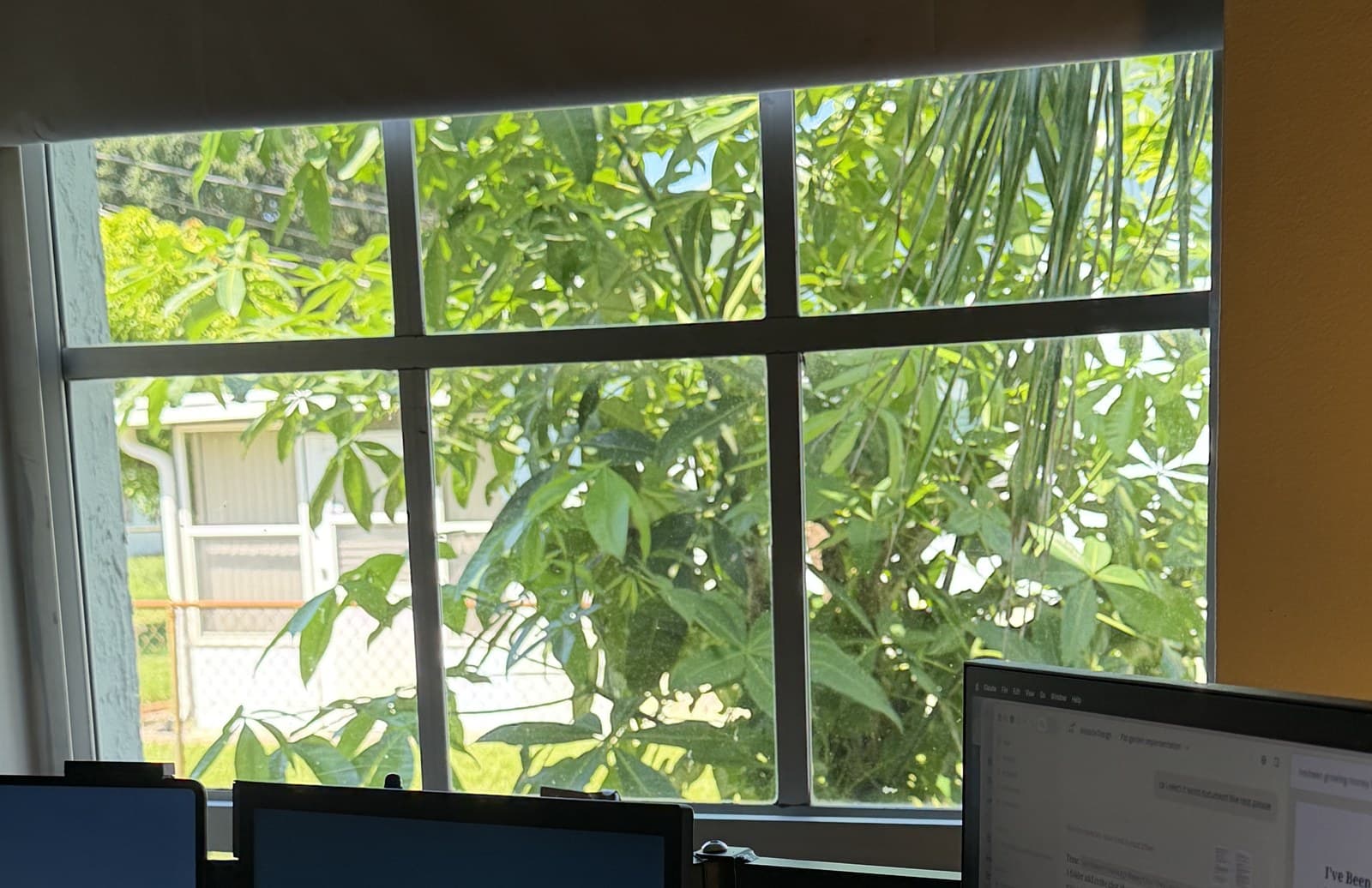
That is the view from my desk. The tree fills the window I look through while I work, and I can see the base of that trunk through the lower panes. I have been on this side of the glass building systems for other people. It has been out there the whole time, doing its own version of the same work at its own pace.
I brought home a plant from a farmers market.
Today it has a trunk I cannot get both hands around. It shades the house. Birds come to it. It is a living part of the landscape.
I didn’t design any of that.
I gave it room.
Maybe there is intelligence in that, too. Knowing when to design, when to adjust, and when not to interfere with something that already knows how to grow.
So yes. I’ve been growing a Money Tree for twelve years.
Shade. Birds. Roots. A living part of the landscape.
And somehow, while I was meandering through my life, it became part of a garden filled with things gathered, learned, remembered, and carried home.
Abundance, it turns out, comes in more forms than one.