
When to Slow Down, Part 8. A series about gardening, stewardship, observation, operational intelligence, and the lessons that quietly shape how we build our lives, our businesses, and our technology.
Last winter, I thought I had lost my lemongrass.
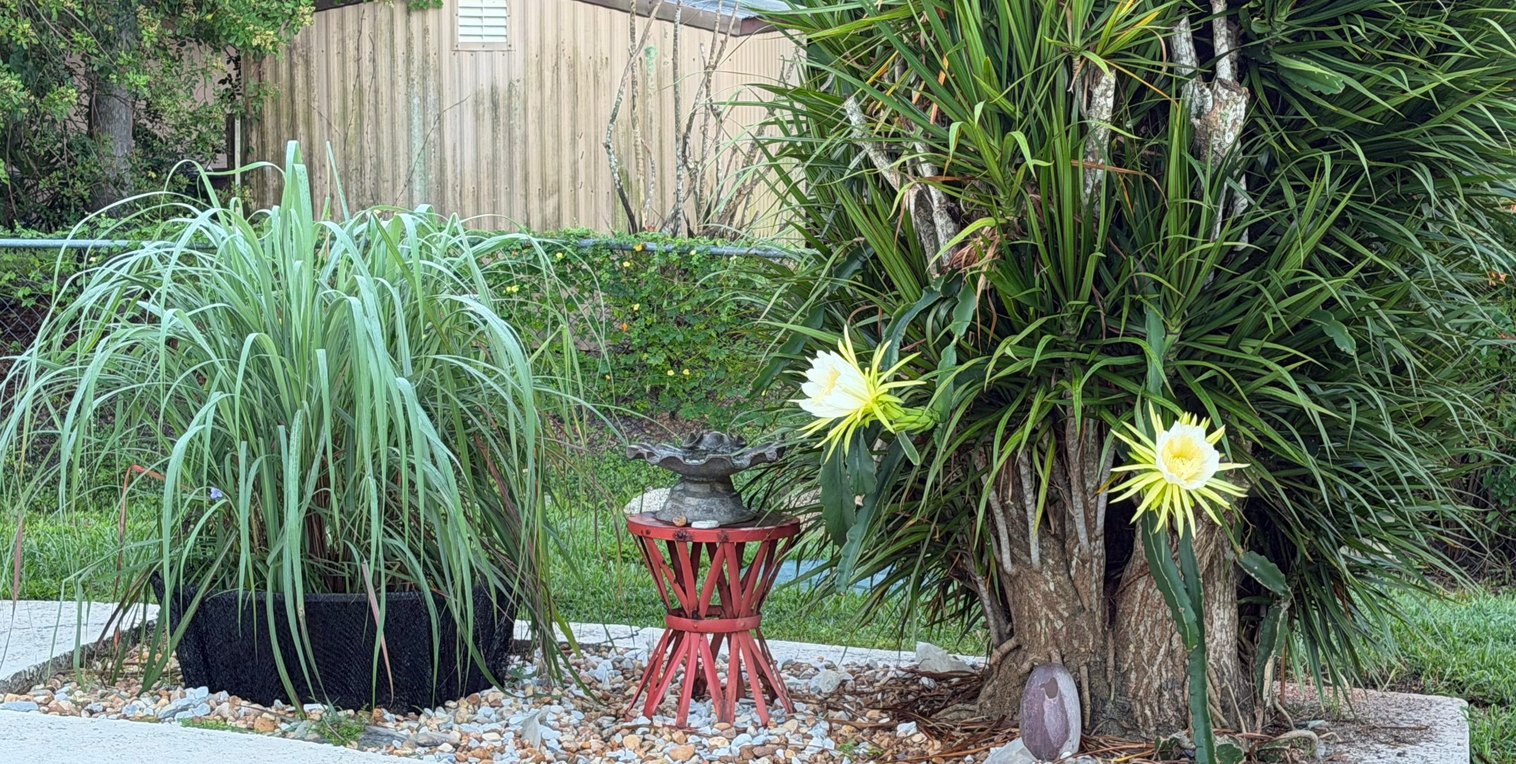
The freeze had taken its toll on the garden. The clump of lemongrass beside the pool had turned brown, its long leaves collapsed into a sorry-looking heap. The sugar apple tree had suffered too, losing most of its leaves and leaving me to wonder whether it would recover. Even the dracaena by the pool, where the dragon fruit climbs, had not escaped the cold.
I was disappointed. Gardening teaches us that not everything survives every season.
Or so I thought.
By late May, something was growing in the lemongrass planter. I was delighted, and a little confused, because what came up looked remarkably like corn.
Readers of I Thought It Was Corn will remember that the mysterious crop turned out to be millet, courtesy of the birds.
While I was busy investigating this unexpected agricultural contribution, something else was happening beneath the surface.
The lemongrass was coming back.
And it had no intention of being subtle.
A Summer of Recovery
In July, the lemongrass was still finding its footing. It shared the planter with the millet, whose dark seed heads stood well above it, and new green shoots were working their way up through the crowd. The plant was a fraction of its former size. I was pleased to see it alive.
By August, things had changed. The clump had thickened, the leaves grew longer, and it began to resemble the plant I remembered.
Now, in October, it is magnificent.
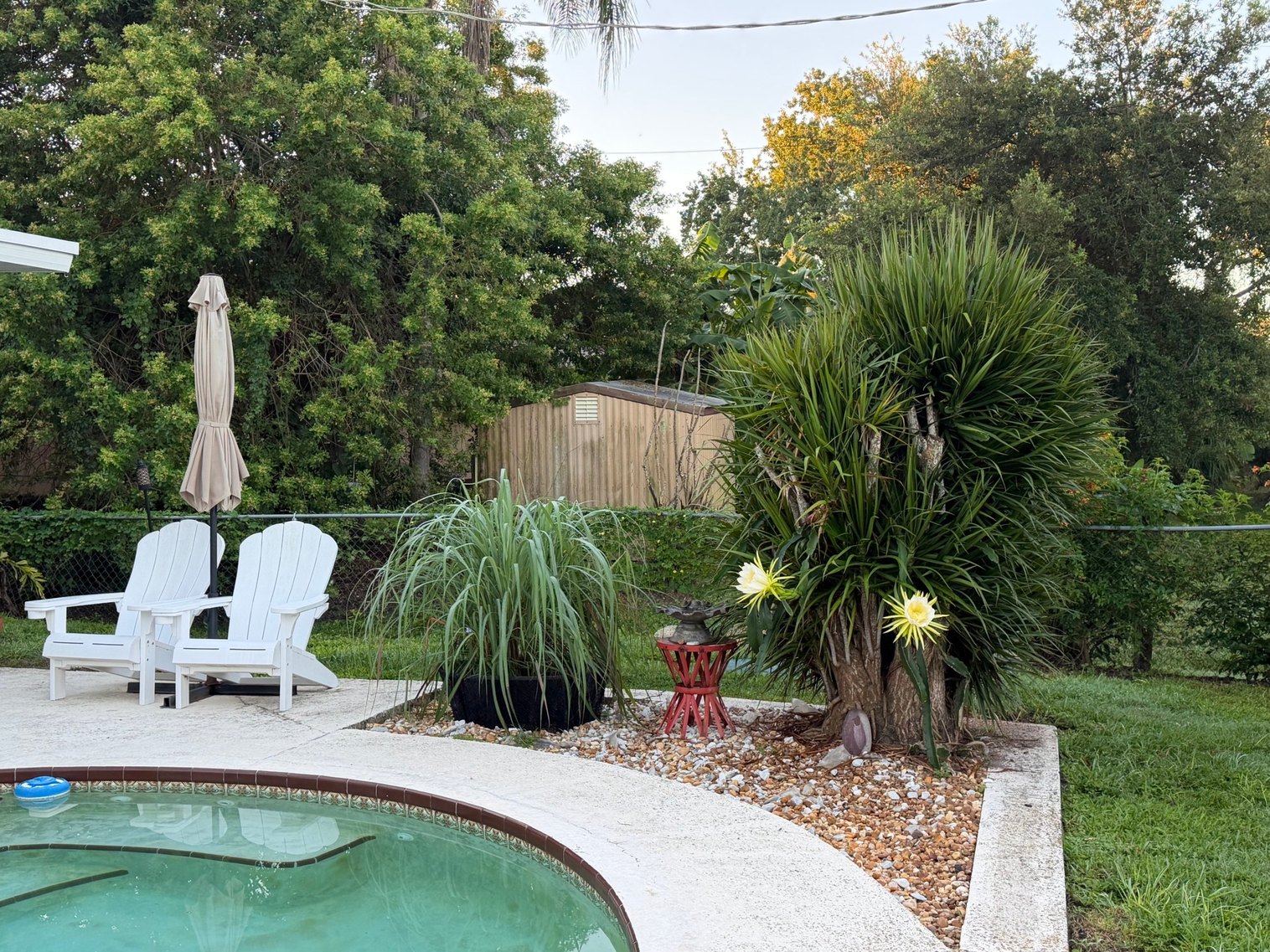
The millet is gone; its season is finished. Long, graceful blades spill over every side of the black planter, dense and vibrant, and the lemongrass has reclaimed nearly every inch of its former space.
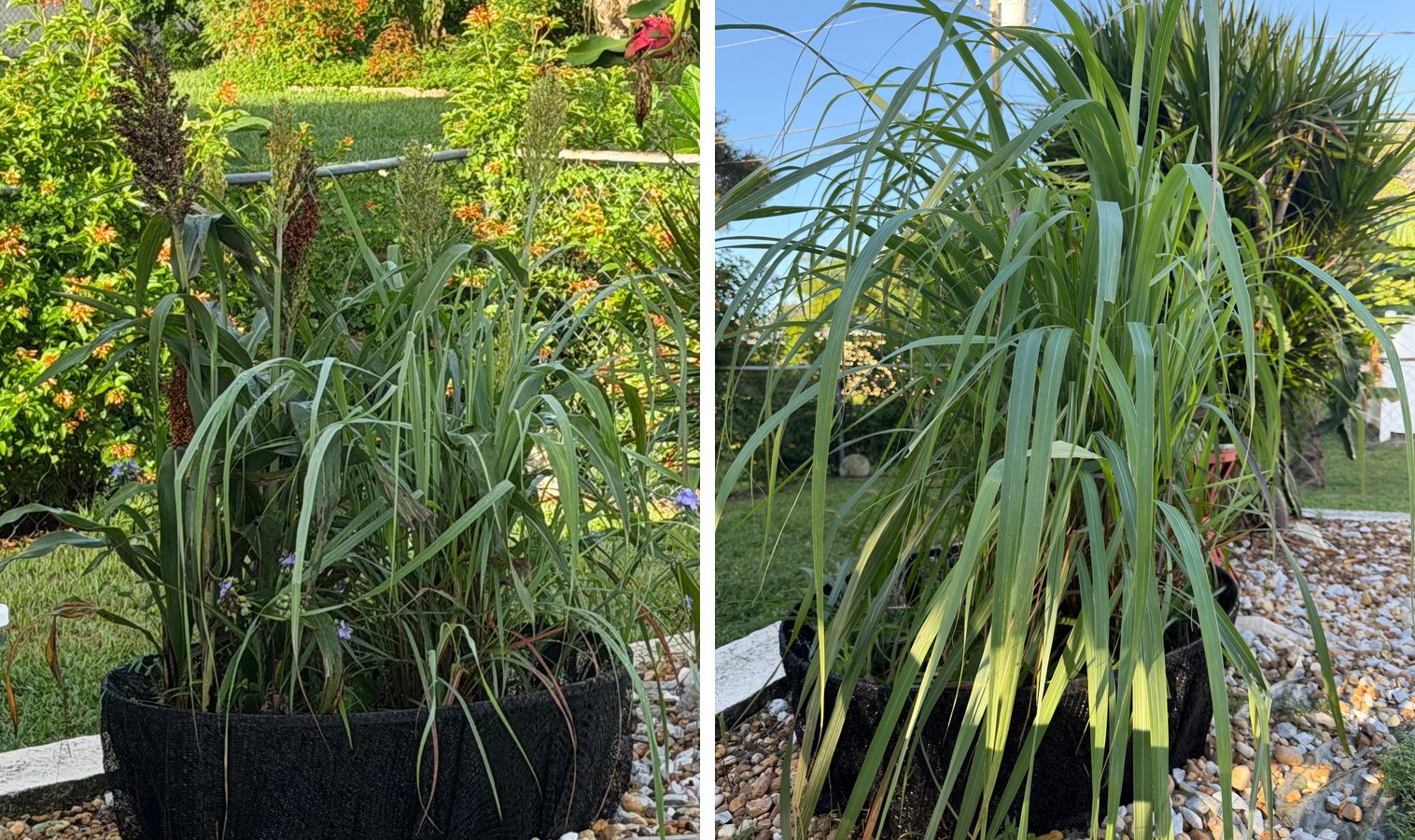
I might even argue that it looks better than it did before the freeze. I have begun to wonder whether the cold killed it or merely offended it.
Apparently, nobody told the lemongrass that it had been pronounced dead.
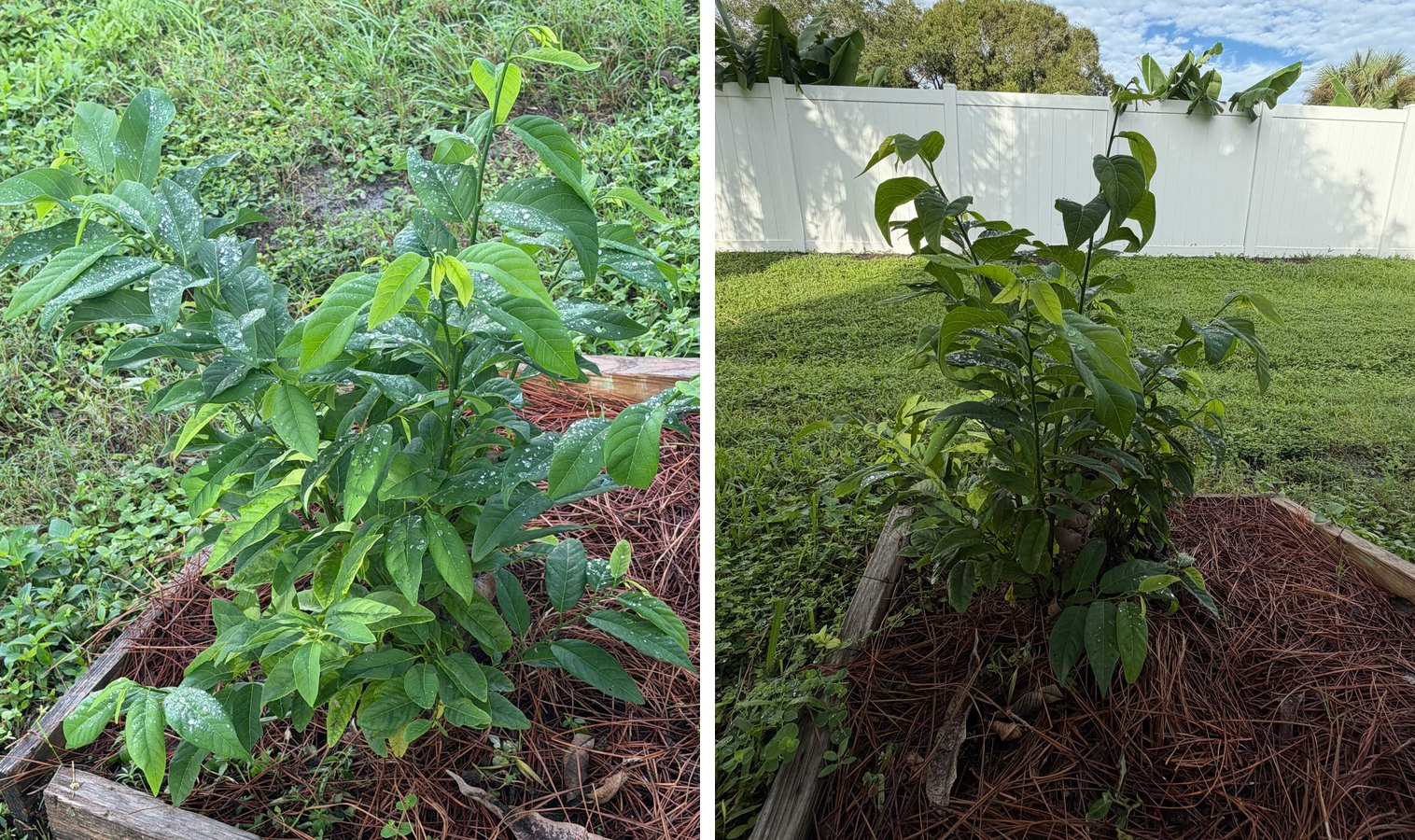
The sugar apple is recovering. Its progress is slower, but no less encouraging. New branches and clean green leaves have filled in where winter left bare stems, and it sits in its raised bed under a fresh layer of pine straw, looking more like a young tree every week.
No sugar apples this season. The tree seems to be focusing on infrastructure before production.
I can respect that.
The Garden Doesn’t Follow My Calendar
Meanwhile, the rest of the garden has carried on with its own agenda.
The mango tree has flourished through the summer, full and dark green against the sky. The moringa is growing beautifully beside it, its feathery canopy spreading wider every month.
And the dragon fruit has once again exceeded my expectations.
Even now, in October, it is flowering. The great white and yellow blossoms open at night along the stems that climb through the dracaena by the pool, and by morning they are still there to greet me. Red fruit has been hanging there for weeks.
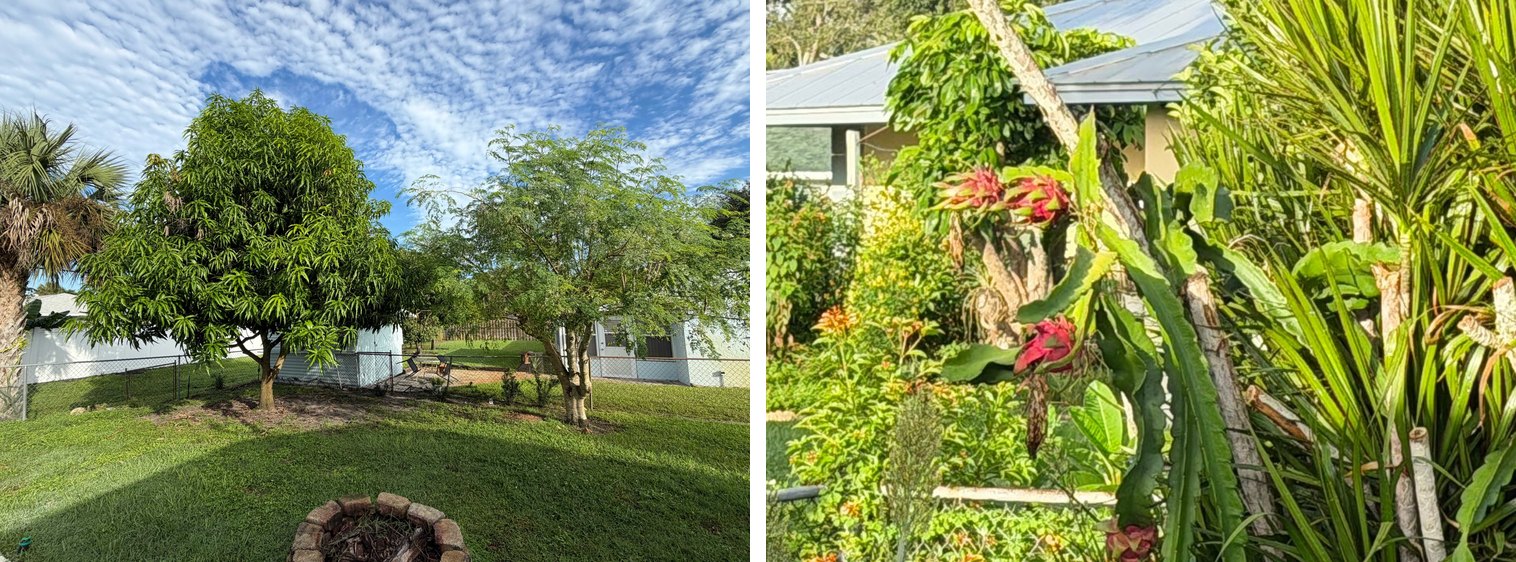
The dracaena suffered in the freeze as well, and it has spent the summer regaining its height. So the dragon fruit is flowering at full strength on a support that is still rebuilding itself. I am not sure the dragon fruit has noticed.
I suspect this may be its final performance of the season, although I have learned to be cautious about such declarations. The dragon fruit has already shown a remarkable talent for proving me wrong. It is still flowering, seemingly unaware that I have written about its remarkable season. Twice.
Looking around, I am struck by how differently the plants have responded this year.
Some have grown vigorously. Others have spent months recovering. A few have produced more than I imagined possible. And some, like the sugar apple, have put their energy into preparing for another season.
The garden doesn’t measure success by how much every plant produces at the same time. Each responds according to its nature, its circumstances, and the strength of what supports it.
Which brings me back to the lemongrass.
What Remains Beneath the Surface
When I thought the lemongrass was dead, I was judging it by what I could see.
Its leaves were gone. Its growth had stopped. Everything above the soil suggested that the plant had reached the end of its life.
But beneath the surface, its roots were alive.
The foundation had survived.
When warmth returned, the plant didn’t need to start from scratch. It had an established root system ready to support new growth.
What looked like a new beginning was a continuation.
I’ve been thinking about that distinction.
We often celebrate reinvention as though it requires abandoning everything that came before. We talk about starting over, transforming ourselves, and building something entirely new.
But how often do we consider what makes reinvention possible?
Is it our ability to change that allows us to survive? Or is it the strength of our foundations that lets us change?
I suspect the answer involves both.
A strong foundation does not guarantee survival. Conditions can become too severe, resources can run out, and even well-established systems can fail.
But without a foundation, there may be little left to rebuild upon.
That is as true in business as it is in the garden.
The Business of Growing Again
I have spent 27 years working in technology.
In that time, I have watched entire industries emerge, mature, and transform. Technologies that once seemed revolutionary have become ordinary, while others have almost entirely disappeared.
I have also watched businesses struggle to adapt. Sometimes they lacked the resources to change. More often, they had become too comfortable with what they already knew.
Success carries a peculiar danger.
When something works well for a long time, we begin to assume it will keep working.
We build processes around it. We invest in infrastructure. We develop expertise, establish relationships, and create organizations designed to support one particular way of operating.
Over time, those structures become familiar. Familiarity is reassuring.
Until the conditions change.
Artificial intelligence is one of those changes.
For many businesses, AI is an opportunity to improve operations, preserve knowledge, and develop new capabilities. For others, it raises difficult questions about existing business models, workforce skills, security, and the future of their industries.
The temptation is to respond by adopting whatever new technology looks most promising.
But technology alone does not create a strong organization.
A business must understand what it does, why it matters, how it organizes its knowledge, and which capabilities are essential to its future.
Otherwise, reinvention becomes little more than replacing one set of tools with another.
And sometimes the new tools are considerably more expensive.
When the Roots Themselves Need Attention
This lesson has another side.
The lemongrass recovered because its roots were healthy enough to support new growth.
But what happens when the foundation itself is no longer strong enough? What happens when the roots are damaged, crowded, or can’t support what the plant needs to become?
In business, foundations are not always strengths.
An organization may be deeply rooted in outdated processes, scattered information, or assumptions that no longer reflect the world around it.
Its institutional knowledge may live almost entirely in the memories of a few experienced people.
Its technology may have been designed for circumstances that no longer exist.
Its leadership may be so focused on preserving what worked yesterday that it struggles to recognize what tomorrow requires.
In those situations, preserving the foundation without examining it becomes an obstacle to growth.
This is where continuous learning matters most. Not only learning the latest software or keeping up with artificial intelligence, but developing the habit of questioning our own assumptions.
What do we know?
How do we know it?
What have we learned through experience?
What knowledge have we failed to preserve?
And perhaps most importantly, what are we holding on to only because it has always been there?
These are questions I ask in my own work.
As a business owner, inventor, and technology architect, I have reinvented parts of my work many times. Yet the principles that guide me have stayed remarkably consistent.
Curiosity. Responsibility. Stewardship. A commitment to learning, and a belief that technology should serve meaningful human purposes.
The tools change. The foundation continues to evolve. And I continue learning.
Growth Is Not Always Production
Watching the sugar apple recover has reminded me of something else.
Not every season is meant for producing fruit.
Sometimes the work is happening where we cannot easily see it. A tree may spend months rebuilding its branches and leaves before it has the strength to produce again.
A business may need to invest in its people, systems, or knowledge before the benefits become visible.
A person may need time to learn, to reconsider, or to arrive at a different understanding of what comes next.
We live in a world that places enormous value on visible productivity. We measure growth in revenue, output, expansion, and, increasingly, speed.
But speed without direction can be costly.
And growth without a foundation is hard to sustain.
The sugar apple has produced no fruit this year.
Yet I consider its recovery a success.
It is alive. It is growing. It is preparing for what comes next.
That is enough for this season.
Looking Toward Winter
It is October in Florida, and the garden is changing again.
The summer heat is easing. The days are growing shorter, and I am looking forward to planting vegetables, preparing the raised beds, and watching another growing season unfold.
I am hoping for a mild winter and a bountiful garden.
The mango, moringa, sugar apple, and dracaena keep growing. The dragon fruit may finally be nearing the end of its extraordinary season.
And the lemongrass stands alone in its planter, full and beautiful, with little evidence of what it endured a few months ago. In November, I am looking forward to making tea from it for my mom’s tea party.
I see it differently now.
Not because it survived the freeze, but because of what made its recovery possible.
Its roots.
The part I couldn’t see.
The part I had almost forgotten was there.
As I look ahead to another season in the garden and another chapter in my work, I am reminded that reinvention does not always begin with something new.
Sometimes it begins by examining what remains.
Understanding what still gives us strength.
Recognizing what needs attention.
And having the wisdom to know what to preserve, what to change, and when to begin again.
The lemongrass has made a convincing argument for strong foundations.
The sugar apple is taking its time.
And the dragon fruit, apparently, is still accepting applications for an extended summer.
I think I’ll let them carry on.
After all, there is still plenty to learn.
• • •